



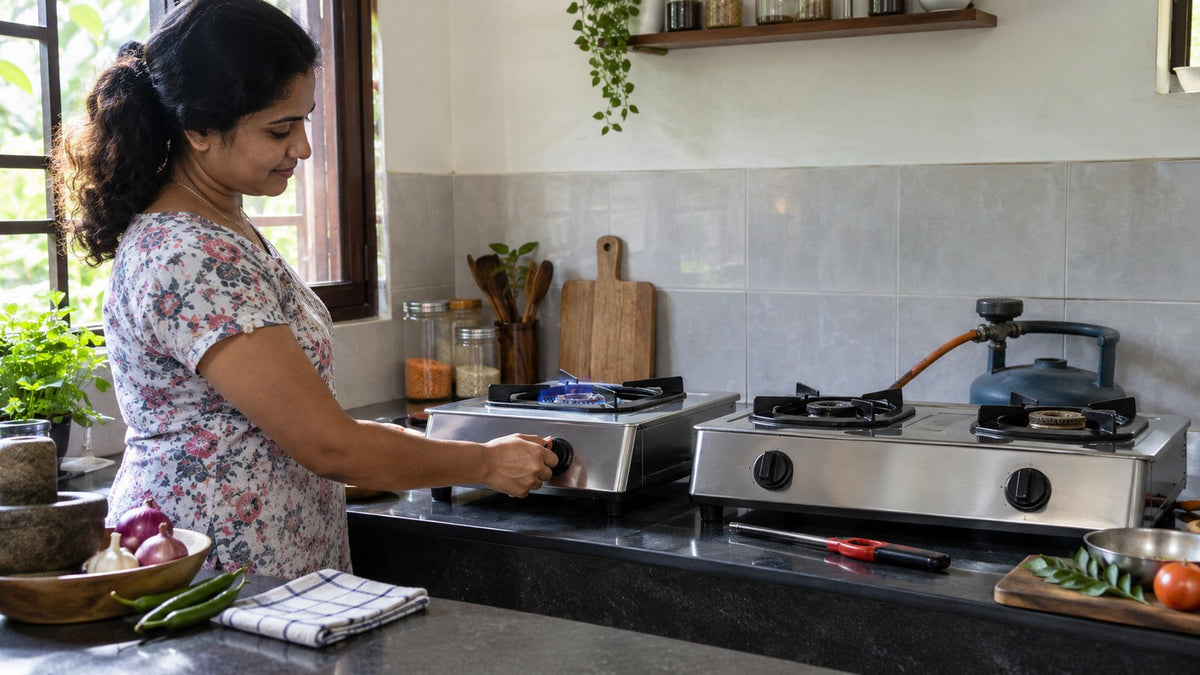
Auto-Ignition vs Manual Gas Stoves: Worth the Extra Money?
Walk into any appliance shop in Colombo and you'll see two kinds of gas stoves (also called gas hobs) sitting side by side: one where you press a knob and a spark lights the burner, and one where you still reach for a lighter or matchstick. In many shops the auto-ignition version costs a little more. Whether that's worth it depends on how the mechanism actually works and what happens to it after two or three years in a humid Sri Lankan kitchen.
Quick answer
- Auto-ignition makes a spark when you turn the knob, either with a piezo crystal or a battery.
- The usual fault is a dirty or wet electrode. Wipe it dry before assuming the stove is broken.
- It is a convenience and safety choice, not a money saver: matches cost very little.
- Our range has both: GreenChef Chandini auto ignition (Rs 11,999) and GreenChef Ebony manual (Rs 12,699).
In this guide
How does auto-ignition actually work?
Auto-ignition gas stoves use one of two mechanisms. One is a piezo-electric igniter, a small ceramic crystal that generates a spark when you press or turn the knob, similar to how a piezo lighter works. There's no battery involved; the mechanical pressure itself creates the electric charge that jumps across the electrode to ignite the gas. The other type uses a battery-powered electronic spark, typically a single AA battery that needs replacing every 12 to 18 months depending on use.
With either type, the spark and the gas release happen in the same turn of the knob. Ask us which ignition type a particular stove uses before you buy, so you know whether it will ever need a battery.
What actually goes wrong with auto-ignition, and can it be fixed?
The most common failure isn't the ignition mechanism itself. It's the electrode getting fouled with spilled dhal, oil splatter, or moisture from steam-heavy cooking like rice and kottu. When the spark stops firing reliably, wiping the electrode tip dry and clean with a cloth solves it in most cases. If the piezo crystal itself has genuinely failed after years of use, it's a small, inexpensive replacement part rather than a reason to replace the whole stove, though this is rare on a well-maintained unit.
Battery-type electronic ignition fails differently: when the battery runs low, the spark gets weak or stops entirely, and people often assume the stove is broken when it just needs a new AA battery. If your auto-ignition stove suddenly stops sparking, check for moisture on the electrode first, then consider whether it's a battery model before assuming anything more serious.
| Auto-ignition | Manual (match or lighter) | |
|---|---|---|
| How it lights | Piezo or battery spark built into the knob | You supply the flame |
| Common failure point | Electrode fouled by spills or moisture; battery on battery models | Nothing to fail |
| Fix when it stops | Wipe the electrode dry; replace the battery if it has one | Not applicable |
| Daily convenience | One motion: turn the knob, the burner lights | Needs a lighter or matches within reach |
| Homes with children or elderly | No loose matches or lighters near the gas | Slightly more risk from handling a flame near gas |
Does the lighter-cost math actually favour auto-ignition?
A box of safety matches costs very little and lasts a few weeks of daily cooking, so the running cost of manual ignition is genuinely small; this isn't really a fuel-savings decision. The real case for auto-ignition is convenience and a small but real safety improvement: no loose matchsticks or lighters stored near an LPG cylinder, no fumbling for a light with wet or oily hands while a curry is already on another burner, and one less thing to remember to have on hand. For a family cooking three meals a day, that adds up to a genuinely easier kitchen routine, even if it isn't a big money-saver.
Where auto-ignition earns its keep is in households where the stove gets used constantly through the day (tea in the morning, rice and curry at lunch, another round in the evening), because the convenience compounds with frequency. If your stove sees light, occasional use, the price premium buys you less in practice.
If you're deciding between models, the GreenChef Chandini 2 Burner (auto ignition, Rs 11,999) is a solid starting point, and the GreenChef Elite 3 Burner (auto ignition, Rs 15,000) suits larger families who need rice, curry and a side dish going at once. If you'd rather have a manual stove, the GreenChef Ebony 2 Burner glass top (Rs 12,699) is our manual-ignition option. In our own range, the price is set more by the glass top and burners than by the ignition type.
Frequently Asked Questions
Does auto-ignition use gas even when it doesn't light the burner?
No. The piezo spark and gas valve are mechanically linked, so pressing the knob releases gas and creates the spark in the same motion. There's no gas release without an ignition attempt, and no gas wasted by the ignition system itself.
Why has my auto-ignition stove stopped sparking?
The most common cause is a fouled electrode from oil splatter, spilled curry, or steam moisture. Wipe the electrode tip dry with a clean cloth first. If your model uses a battery, check and replace it before assuming the mechanism has failed.
Is a manual gas stove less safe than auto-ignition?
Both are safe when used correctly. Auto-ignition slightly reduces risk by removing the need to handle an open matchstick or lighter near the stove and cylinder, but a manual stove used with normal care is not inherently dangerous.
Can I convert a manual gas stove to auto-ignition later?
Generally no. The ignition mechanism is built into the burner and knob assembly at manufacture, so it isn't a retrofit you can add afterward. This is worth deciding at purchase rather than upgrading later.
Which lasts longer, auto-ignition or manual stoves?
The burner and body last the same either way; ignition type doesn't affect the core stove's lifespan. The only added wear part on auto-ignition is the piezo electrode or battery, both of which are simple, low-cost to maintain or replace.
Need a hand choosing?
If convenience and fewer loose lighters around your cylinder matter to your household, auto-ignition is worth choosing. Visit our Colombo showroom, or WhatsApp us on 0776882898, and we'll show you both types side by side.
Shop Gas Cookers & HobsWarranty & RepairsWhatsApp 0776882898