

Mixer Grinder vs Wet Grinder Sri Lanka: What's the Difference?
If your kitchen makes thosai, hoppers, or string hoppers from scratch on a regular Sunday morning, whether you're in a Jaffna household with a wet grinder handed down a generation or a Colombo apartment kitchen deciding whether to buy one for the first time, you've probably wondered whether you actually need a wet grinder, or whether the mixer grinder you already own for chilli paste and pol sambol can do the job just as well. It's a fair question. The two machines look like they do similar work, but they're built around completely different grinding mechanisms, and that difference shows up directly in the texture of your batter. Here's what actually separates a mixer grinder from a wet grinder, and which one your household genuinely needs.
Quick answer
- A mixer grinder uses fast blades: sambols, chutneys and dry spices in seconds.
- A wet grinder uses slow stone rollers for 30 to 45 minutes and makes lighter, better-fermenting batter.
- Most households only need a mixer grinder. Add a wet grinder if you make thosai or hopper batter from scratch every week.
- GreenChef 1HP mixer grinders with 3 jars are Rs 13,999 to 14,000 at Green Life.
In this guide
- What's the Actual Difference Between a Mixer Grinder and a Wet Grinder?
- Which One Makes Better Batter for Thosai, Hoppers and String Hoppers?
- How Much Batter Can Each Machine Handle in One Go?
- How Long Does Each One Actually Take?
- What Does Each One Cost in Sri Lanka?
- Which One Should Your Household Actually Buy?
- Frequently Asked Questions
What's the Actual Difference Between a Mixer Grinder and a Wet Grinder?
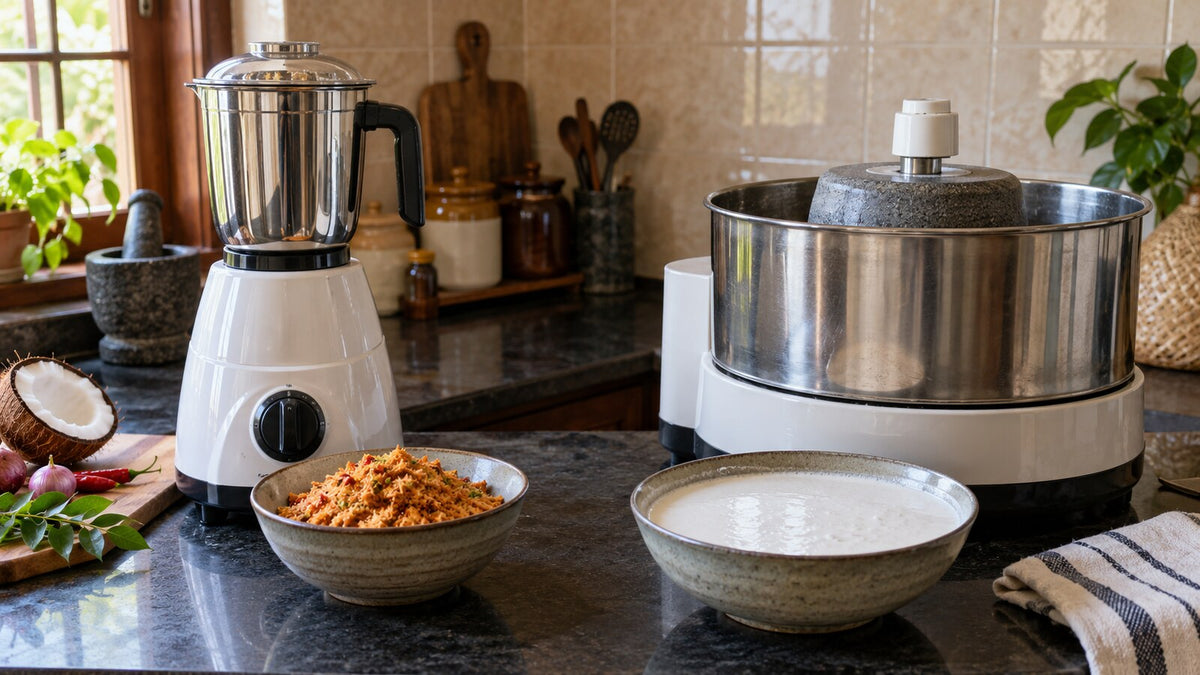
A mixer grinder works by spinning sharp stainless steel blades at very high speed, inside a sealed jar. It's fast, powerful, and versatile: the same machine handles dry spice grinding, chilli paste, coconut sambol, chutneys, and quick blending, usually in under a minute per jar.
A wet grinder (sometimes listed as a "wet and dry grinder" by other retailers, since many modern models handle both) works completely differently. Instead of blades, it uses slow-turning granite or stone rollers inside a stainless steel drum, grinding rice and lentils between the stone and the drum wall at low speed over a longer period, typically 30 to 45 minutes for a full batch. That slower, cooler grinding action is what gives stone-ground batter its characteristic light, aerated texture, which matters a great deal when you're making thosai or hoppers, since a well-aerated batter ferments and rises better.
Which One Makes Better Batter for Thosai, Hoppers and String Hoppers?
If you make hopper or thosai batter from scratch (soaking and grinding rice and urad dal yourself rather than buying ready-made hopper flour), a wet grinder produces a noticeably better result. The slow stone-grinding action doesn't generate much heat, which helps the batter ferment properly overnight, and the finer, more uniform texture gives hoppers their characteristic soft, lacy edge and thosai their even crispness.
A mixer grinder can grind the same rice-and-dal mix, but the high-speed blades generate more heat and produce a slightly coarser, less consistent texture. For occasional hopper-making, most households find this perfectly acceptable. For families who make thosai or hoppers weekly or more, the difference is usually noticeable enough to justify a dedicated wet grinder.
How Much Batter Can Each Machine Handle in One Go?
A mixer grinder jar is sized for everyday jobs, which is fine for spice pastes, chutneys, and small blending jobs, but you'd need to grind in several batches to prepare enough batter for a family breakfast. A table-top wet grinder, by contrast, is built to grind a full family-sized batch of hopper or thosai batter in a single run, one of the main reasons households that cook this way in volume prefer it.
How Long Does Each One Actually Take?
This is where the two machines are furthest apart. A mixer grinder finishes most jobs in 30 seconds to two minutes. A wet grinder takes 30 to 45 minutes to grind a full batch, since the stone-grinding process is deliberately slow; rushing it by using a faster machine is exactly what produces the coarser texture a mixer grinder gives you. If you're grinding batter the night before, the extra time isn't a practical downside; if you're trying to make hoppers on short notice, it is.
What Does Each One Cost in Sri Lanka?
Prices vary by motor size, jar count and drum capacity. Here is what the mixer grinders cost at Green Life:
| Appliance | Price at Green Life (30 Sep 2026) | What drives the price |
|---|---|---|
| GreenChef Focal mixer grinder, 550W, 3 jars | Rs 9,999 | Motor power, number of jars |
| GreenChef Mercury or Flen, 1HP, 3 jars | Rs 13,999 to 14,000 | Stronger motor for batter and dry spices |
| GreenChef Flen Plus, 1HP, 3 jars plus juicer jar | Rs 15,000 | Extra juicer jar |
| Table-top stone wet grinder | Not stocked at Green Life | Motor duty cycle, stone quality, drum size |
Green Life does not sell a wet grinder, so for that side of the choice, compare models in specialist shops.
Which One Should Your Household Actually Buy?
For most Sri Lankan kitchens, a good mixer grinder alone covers most daily grinding needs: pol sambol, chilli paste, curry pastes, chutneys, and dry spice grinding. If your household doesn't regularly make thosai, idli, or hopper batter from scratch, you likely don't need a wet grinder at all.
If you do make South Indian-style breakfasts or hoppers from scratch weekly, a dedicated wet grinder is worth the extra cost. The batter quality difference is real, not marketing. Many households end up owning both: a mixer grinder for daily cooking and a wet grinder reserved for batter days.
For daily sambols, chutneys and spice grinding, the GreenChef Mercury Mixer Grinder (1HP, 3 stainless steel jars, Rs 13,999) and the GreenChef Flen (1HP, 3 jars, Rs 14,000) cover the job. If you also want juice, the GreenChef Flen Plus adds a juicer jar for Rs 15,000. For dedicated batter-making you would need a stone wet grinder, which we do not stock.
For a closer look at mixer grinders on their own, from motor power to jar count, see our Mixer Grinder Buying Guide Sri Lanka.
Frequently Asked Questions
Can a mixer grinder make thosai or hopper batter?
Yes, but the texture is coarser and the batter often doesn't rise as well, since the blades generate heat and don't aerate the rice-and-dal mix the way a stone wet grinder does. It works fine for occasional hoppers; regular thosai-makers usually prefer a dedicated wet grinder.
Do I really need both a mixer grinder and a wet grinder?
Only if you make thosai, idli, or hopper batter from scratch regularly, once a week or more. If you buy ready-made hopper flour or only make batter occasionally, a good mixer grinder alone handles sambols, chutneys, and spice grinding without the extra cost.
Which one is easier to clean?
A mixer grinder's jars detach and wash like any container. A wet grinder's stone drum needs a bit more care; rinse it promptly after use so batter doesn't dry onto the stones, and avoid letting water sit in the motor base.
Is a wet grinder worth the extra price over a mixer grinder?
For households that regularly make South Indian-style breakfasts, yes. The batter quality difference is noticeable in both taste and rise. For general Sri Lankan cooking such as sambols, curries, and chutneys, a mixer grinder handles nearly everything for less money.
Not sure whether your kitchen needs one machine or both? Tell us what you cook most on WhatsApp, 0776882898, and we'll point you to the right setup before you spend on a machine you won't use daily.
For the full room-by-room kitchen setup, including where a mixer grinder fits into a starter, mid, or complete kitchen budget, see our Complete Sri Lankan Kitchen Setup Guide.
Need a hand choosing?