



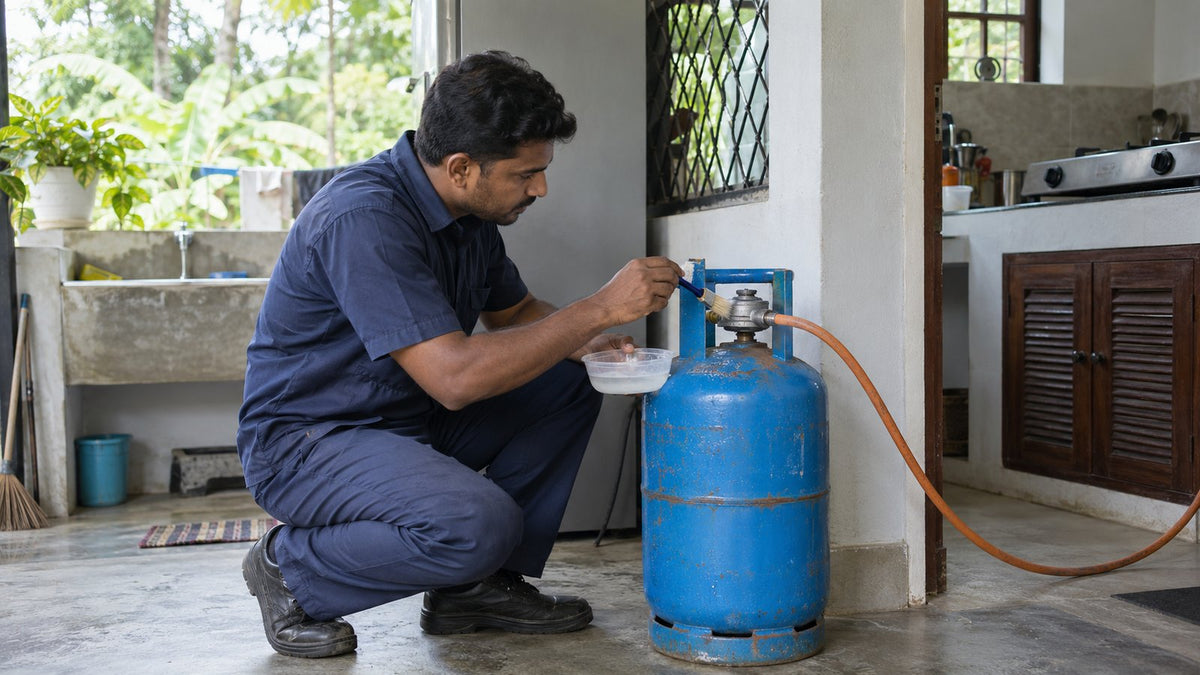
Gas Cylinder Safety at Home: A Checklist Every Sri Lankan Household Should Run
A simple checklist for the regulator, hose and stove, so the LPG cylinder under your counter stays safe.
Gas cylinder safety in a Sri Lankan kitchen isn't complicated, but it's the kind of thing most households only think about after a neighbour's story makes the news. A 12.5kg domestic LPG cylinder sitting under your counter is safe equipment when the regulator, hose, and stove are in good condition. The risk almost always comes from a perished hose nobody checked, a regulator that's outlived its seal, or a kitchen with no airflow. This is a ten-minute checklist worth running tonight, not after something goes wrong.
Quick answer
- Check the hose every month, replace it every 2 years and replace the regulator every 5 years.
- Do the soap water leak test on every new cylinder. Bubbles at a joint mean gas is escaping.
- LPG is heavier than air and pools near the floor, so keep the kitchen ventilated while cooking.
- Smell gas? No switches, close the cylinder valve, open windows and leave the room.
In this guide
- Why gas cylinder safety checks matter in a Sri Lankan kitchen
- How often should you check your regulator and hose?
- The soap water leak test (step by step)
- Ventilation: why a sealed kitchen is dangerous
- What is a flame failure device, and does your stove have one?
- What to do if you smell gas
- The full checklist
- Frequently Asked Questions
Why gas cylinder safety checks matter in a Sri Lankan kitchen
Most Sri Lankan kitchens run LPG daily, often for years on the same hose and regulator without a second thought. Rubber hoses degrade with heat and time: a hose sitting close to a hot burner for three or four years is not the same hose it was on day one, even if it looks fine from a metre away. Coastal and high-humidity homes see this faster, since damp air accelerates rubber perishing at the fittings. None of this requires alarm, just a routine.
How often should you check your regulator and hose?
Check the hose visually every month: look for cracking, swelling, or a shiny/brittle patch anywhere along its length, especially near the stove and cylinder ends. Replace the hose every two years regardless of how it looks, and replace the regulator if it's more than five years old or if you notice a hissing sound, a burnt-rubber smell, or a flame that won't hold steady blue. A replacement hose and regulator set typically costs Rs 1,500 to 3,500 in Sri Lanka depending on hose length and regulator type: a trivial cost against the risk of running a compromised one for another year.
The soap water leak test (step by step)
This is the single most useful five-minute safety check any household can do, and it needs no special equipment.
- Mix a small amount of dish soap with water in a cup.
- With the cylinder valve open and the stove off, brush the soapy mixture over every joint, the cylinder valve connection, the regulator, and both ends of the hose.
- Watch for bubbles. Steady bubbling at any joint means gas is escaping there.
- If you see bubbles, close the cylinder valve immediately, ventilate the kitchen, and do not light the stove until the fitting is replaced or tightened by someone who knows what they're doing.
- Run this test every time you connect a new cylinder, and again every few months on the existing setup.
Ventilation: why a sealed kitchen is dangerous
LPG is heavier than air, so a leak doesn't rise and disperse. It settles and pools near the floor. A kitchen with no window, no gap under the door, and an exhaust fan that's never switched on is the worst-case setup for a slow leak going unnoticed. If your kitchen is small and enclosed, common in compact Colombo apartments, keep a window cracked when cooking and consider a cooker hood or extraction fan that vents outside, not just recirculates air back into the room.
What is a flame failure device, and does your stove have one?
A flame failure device (FFD) is a small safety mechanism built into the burner valve that automatically cuts gas flow if the flame goes out unexpectedly, from a sudden gust, a spill, or a pot boiling over. Without an FFD, gas keeps flowing silently even after the flame is gone, which is how kitchens fill with unburned gas without anyone noticing until it's too late. It's worth asking specifically about this feature on any stove you're considering, because not every stove has one.
Safety first
What to do if you smell gas
Don't switch on any electrical device, including lights or fans. A spark from a switch can ignite pooled gas. Don't light a match to "check." Instead: turn off the cylinder valve at the source, open doors and windows to ventilate, leave the room, and only return once the smell has fully cleared. If the smell persists after the valve is closed, call your gas supplier's emergency line before doing anything else.
The full checklist
- Hose checked visually: monthly
- Hose replaced: every 2 years
- Regulator replaced: every 5 years, or sooner if hissing/smell present
- Soap water leak test: on every new cylinder, then every few months
- Kitchen ventilated while cooking: always
- Stove has a working flame failure device: confirmed
- Emergency plan (valve location, supplier number) known to every adult in the house: yes
If you're due for a stove upgrade anyway, look for one with auto-ignition and a built-in flame failure device rather than treating it as an optional extra, and ask us which models in the Green Life gas cooker and hob range have one. Every model comes with a 1-year warranty.
Frequently Asked Questions
How often should I replace my LPG hose?
Every two years as routine maintenance, sooner if you see cracking, swelling, or a hard/brittle patch anywhere along its length. Coastal and humid homes should check more frequently since damp air speeds up rubber wear at the fittings.
What's the soap water test and why does it work?
Brushing soapy water on every gas joint reveals leaks instantly as bubbles form where gas escapes. It's the simplest reliable home test: no equipment beyond dish soap and water, and it takes about five minutes to check a full connection.
What does a flame failure device actually do?
It automatically shuts off gas flow to a burner if the flame goes out unexpectedly, preventing unburned gas from continuing to flow into the kitchen unnoticed. Ask us which stoves in our range have one.
I smell gas in my kitchen right now, what do I do?
Don't touch any switches. Turn off the cylinder valve, open windows and doors, leave the room, and let it ventilate fully before returning. Call your gas supplier's emergency number if the smell doesn't clear once the valve is shut.
Questions about your setup?
Run this checklist tonight. It takes ten minutes and it's the cheapest insurance your kitchen will ever get. Questions about your regulator, hose, or whether your stove has a flame failure device? WhatsApp us a photo and we'll help you check: 0776882898.