

Is Non-Stick Cookware Safe? PFOA, PFAS and Teflon Explained for Sri Lankan Kitchens
If you've searched "are non-stick pans toxic" and come away more confused than before, you're not alone. The terms PFOA, PFAS, and Teflon get used interchangeably online, which makes it hard to tell what's an outdated concern, what's genuinely worth knowing, and what applies to the pan actually on your stove. Here's a plain-language answer to whether non stick pans are safe, and what to check on your own pans.
Quick answer
- PTFE (Teflon) is the non-stick coating itself and is stable at normal cooking heat.
- PFOA was a chemical once used in making PTFE; it was phased out by the early 2010s. PFAS is the wider family.
- The real risk is overheating an empty pan on high flame. Cook on medium.
- Replace a pan when the coating flakes, peels or scratches through to the metal.
In this guide
- What Are PFOA and PFAS, in Plain Language?
- Old Teflon vs Modern Non-Stick Coatings: What Actually Changed?
- Is Non-Stick Cookware Safe to Cook On Daily?
- Old-Style Manufacturing vs Modern PFOA/PFAS-Free Coatings
- What Temperature Is Safe for Non-Stick Cookware?
- When Should You Replace a Scratched Non-Stick Pan?
- Our GreenChef Evok non-stick range
- Frequently Asked Questions
What Are PFOA and PFAS, in Plain Language?
PTFE is the actual non-stick coating material, a stable, slippery polymer better known by its original brand name, Teflon. On its own, PTFE is chemically inert at normal cooking temperatures, which is why it doesn't react with food or leach into it during regular use.
PFOA is a different substance entirely: a manufacturing chemical that was historically used by some producers during the process of making PTFE, not an ingredient in the finished coating on your pan. Health and environmental concerns around PFOA led major manufacturers and regulators to phase it out of production processes industry-wide by the early 2010s.
PFAS is the broader umbrella term for a large family of manufactured chemicals, of which PFOA is one member. When a modern non-stick pan is labelled "PFOA-free" or "PFAS-free," it means the coating was manufactured without these specific compounds, which is now the standard across reputable non-stick cookware brands, not a rare premium feature.
Old Teflon vs Modern Non-Stick Coatings: What Actually Changed?
The core non-stick polymer itself hasn't fundamentally changed; PTFE-based coatings still do the job they always have. What changed is the manufacturing process behind it. Older production methods, largely phased out over a decade ago, sometimes used PFOA as part of making the coating. Reputable makers now label coatings made without PFOA as PFOA-free. If your pan is genuinely old, bought well over a decade ago from an unclear source, that's a reasonable prompt to check its origin.
Is Non-Stick Cookware Safe to Cook On Daily?
For regular home cooking, yes, provided the coating is intact and you're not using it in ways it isn't rated for. This isn't medical advice. The two habits that matter for any non-stick pan are avoiding metal utensils and never heating the pan empty on a high flame.
Old-Style Manufacturing vs Modern PFOA/PFAS-Free Coatings
| Older manufacturing | Coatings labelled PFOA-free | |
|---|---|---|
| PFOA used in making the coating | Sometimes, depending on the maker | No |
| Core non-stick polymer | PTFE | PTFE |
| Regulatory status | PFOA phased out in the early 2010s | Current standard for reputable makers |
| Where you'd meet it today | Very old, unclear-origin pans | Most current cookware |
What Temperature Is Safe for Non-Stick Cookware?
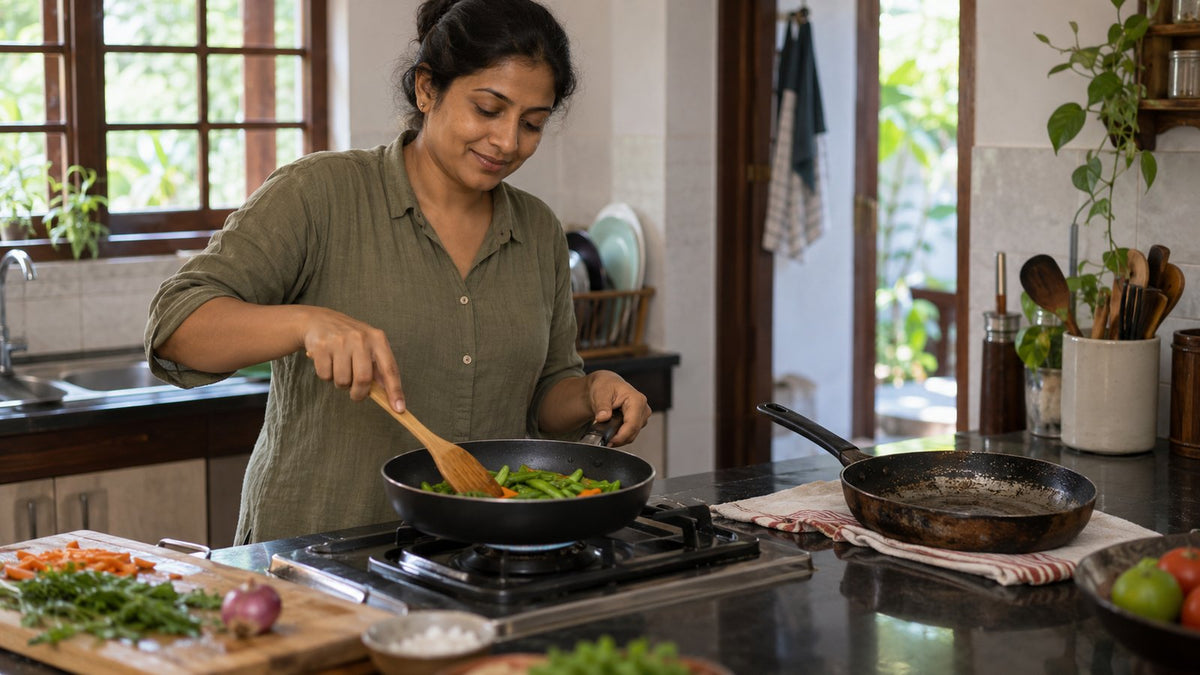
Non-stick coatings are rated for medium heat, generally topping out around 230 to 260°C, well below what an open gas flame on high can push a thin pan to within a few minutes. The real-world risk isn't the coating chemistry itself, it's overheating an empty pan on high flame, which stresses any non-stick coating regardless of brand or manufacturing era. Cooking on medium heat protects the coating and, in practice, cooks Sri Lankan staples like pol sambol tempering, egg curry, or roti on a flat tawa just as well, since non-stick surfaces transfer heat efficiently even at a lower flame setting. It also uses less LPG per cook than repeatedly adjusting a high flame.
When Should You Replace a Scratched Non-Stick Pan?
A few light surface marks after years of normal use don't mean a pan is unsafe. Replace it when you see visible flaking or peeling of the coating, scratches deep enough to expose the metal base underneath, or food sticking consistently even with oil and correct heat. At that point the coating is genuinely compromised, and no amount of careful cooking brings it back. Medium heat, wooden or silicone utensils and hand washing keep a coating going for years.
Our GreenChef Evok non-stick range
We sell the GreenChef Evok flat tawa (Rs 2,800 to 3,250), multipurpose tawa (Rs 3,250 to 3,500), fry pans (Rs 2,499 and Rs 3,250) and the GreenChef Namo kadai (Rs 4,899 and Rs 5,899), as the authorised GreenChef agent for Sri Lanka, each with a 1-year warranty. The same care rules apply to them as to any non-stick pan: medium heat and no metal utensils. For the coating details of a specific pan, WhatsApp us and we'll share what the manufacturer states.
Frequently Asked Questions
Are non stick pans safe for daily cooking?
For a pan with an intact coating used at medium heat, yes. Avoiding metal utensils and never heating an empty pan on high are the two habits that matter most.
What's the difference between PFOA and PFAS?
PFAS is the broad chemical family; PFOA is one specific compound within that family, historically used in some non-stick coating manufacturing processes.
How do I know what coating my pan has?
Check the box or the maker's product sheet. For a GreenChef pan bought from us, WhatsApp us and we'll share what the manufacturer states for that pan.
Is it dangerous to use a scratched non-stick pan?
Light surface wear after years of normal use isn't a practical concern. A pan becomes worth replacing once you see flaking or peeling coating, scratches deep enough to expose the base metal, or food sticking consistently despite oil and correct heat.
Is ceramic-coated cookware safer than standard non-stick?
Ceramic coatings are a different, mineral-based alternative some buyers compare against PTFE-based non-stick, but they aren't inherently safer; both are considered safe when manufactured to current standards and used within their rated heat limits.
Need a hand choosing?
Have a question about a specific pan or want to know if it's time to replace one? WhatsApp us a photo and we'll give you a straight answer: 0776882898.