

Multi Cooker vs Pressure Cooker vs Rice Cooker: Which Do You Actually Need?
"Multi cooker" is a common search in Sri Lanka, and it's also one of the most confusing terms, because the term gets used loosely, sometimes for an imported electric all-in-one device that pressure cooks, slow cooks, and sautés, and sometimes just as a marketing label stuck on a rice cooker with a steaming tray. Before you spend on an electric multi cooker, it's worth understanding honestly what it actually adds over the two appliances most Sri Lankan kitchens already rely on: a stovetop pressure cooker and an electric rice cooker.
Quick answer
- A stovetop pressure cooker is fastest for dhal, red rice, jackfruit and tough meat.
- An electric rice cooker makes rice with no supervision, and its steamer tray handles vegetables.
- An imported multi cooker does both in one unit, but has more parts to fail and is harder to service locally.
- A GreenChef Namo 5L (Rs 7,099) plus a Green Life 1.8L rice cooker (Rs 6,999) covers most of what a multi cooker does.
In this guide
What Does Each Appliance Actually Do Well?
A stovetop pressure cooker uses LPG gas and sealed steam pressure to cook food fast under high heat. It's the appliance behind a 20-minute pot of dhal, a tender beef or mutton curry in under an hour, or a full pot of red rice cooked in a fraction of the time boiling would take. It needs your attention while it's on the stove, but nothing about it is electronic: no motherboard, no sensor, nothing to fail except a rubber gasket that costs a few hundred rupees to replace.
An electric rice cooker does one job extremely well: hands-off, perfectly cooked rice, every time, with zero supervision. Fill it, press the switch, and walk away; it automatically switches to keep-warm once the rice is done. Many models, including both Green Life rice cookers, also come with a steamer tray, so the same appliance handles kiribath, steamed vegetables, and reheating leftovers without dirtying a second pot.
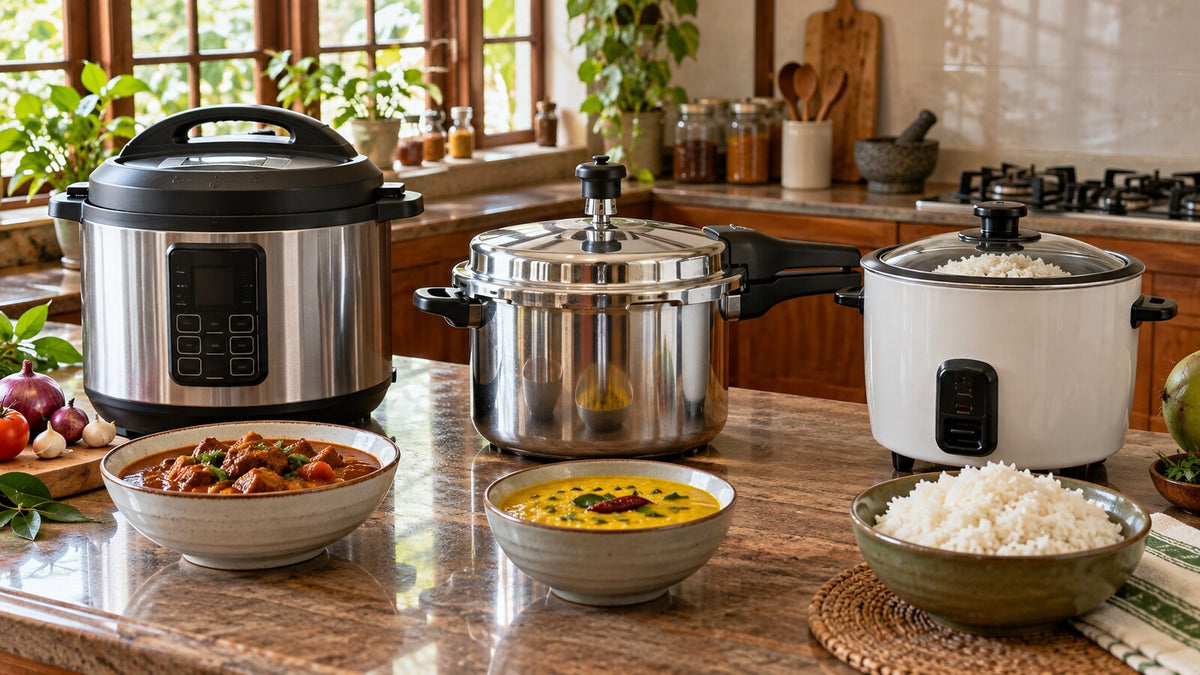
A "multi cooker," in the sense of an imported electric all-in-one appliance, tries to combine pressure cooking, rice cooking, slow cooking, and sautéing into one countertop unit with a digital control panel. When it works, it's genuinely convenient for a household that wants one device instead of two. The trade-off is that it's also one motor, one sensor board, and one seal doing several jobs instead of one, which means more that can go wrong, and in Sri Lanka, meaningfully harder and more expensive to get serviced or find spare parts for than a simple stovetop pressure cooker or basic electric rice cooker.
An Honest Three-Way Comparison
| Pressure Cooker (stovetop) | Rice Cooker (electric) | "Multi Cooker" (electric all-in-one) | |
|---|---|---|---|
| Power source | LPG gas | Electricity | Electricity |
| Best at | Fast, high-heat cooking: dhal, red rice, jackfruit curry, tough meat, whole legumes | Hands-off perfect rice plus steaming (kiribath, string hoppers, vegetables) | Attempting both, plus slow-cook and sauté functions |
| Price | Rs 5,599 to 10,399 at Green Life (GreenChef 3L to 12L) | Rs 6,999 to 8,999 at Green Life (1.8L and 2.8L) | Usually more than a pressure cooker and rice cooker together |
| Supervision needed | Some, you're managing it on a live flame | None, fully automatic | Low for most functions, but pressure mode still needs the same care as a stovetop cooker |
| What can fail | Gasket wears out over time (cheap, easy fix) | Non-stick pot wears over years (simple mechanism) | Sensor board, seals, digital display: more parts, harder and pricier to service locally |
| Who it suits | Households cooking rice-and-curry daily who want fast, familiar stovetop cooking | Anyone who wants "set and forget" rice, students, offices, busy households | Small households wanting one countertop device and comfortable with imported electronics and longer service turnaround |
To be transparent: Green Life doesn't currently stock a dedicated electric all-in-one multi cooker, and we're not going to pretend otherwise or dress up a rice cooker as something it isn't. What we do stock is the combination that covers almost everything a multi cooker promises: a genuine GreenChef stovetop pressure cooker for fast, high-pressure cooking, and a Green Life electric rice cooker with a steamer tray for hands-off rice and steaming, at a combined cost that's usually well under what a single imported multi cooker costs, using simpler technology that's far easier to repair or replace a part for in Sri Lanka.
Which One Should You Actually Buy?
If you cook rice-and-curry most days and want speed on tough dishes like dhal, jackfruit curry, or beef curry, a stovetop pressure cooker is the single highest-value appliance in a Sri Lankan kitchen. It's the one dish-time saver almost every local recipe benefits from. If you want rice handled with zero supervision while you're cooking curries on the stove, an electric rice cooker pairs naturally alongside it, and the steamer tray covers kiribath and vegetables in the same unit. Together, that combination handles the vast majority of what an electric multi cooker is marketed to do, for a lower total cost and simpler long-term maintenance.
An imported multi cooker can still make sense for a specific household: someone in a small apartment with only one usable power point and no gas connection, someone who finds handling a stovetop pressure cooker's pressure release intimidating, or someone genuinely short on counter and storage space who values one device over two. If that's your situation, go in with clear eyes about local servicing; ask any seller directly where you'd get a seal or sensor replaced in Sri Lanka before you buy.
For most Sri Lankan households, though, a GreenChef Pressure Cooker Namo 5L alongside a Green Life 1.8L Automatic Rice Cooker with Steamer is the tested, easily serviced combination that a multi cooker is often trying to replicate. For a full size-by-size breakdown of pressure cooker capacity, see our Pressure Cooker Buying Guide Sri Lanka, and for how these appliances fit into a complete kitchen budget, see our Complete Sri Lankan Kitchen Setup Guide.
Frequently Asked Questions
Is a multi cooker better than a pressure cooker and rice cooker combo?
Not necessarily. A multi cooker saves counter space and offers programmable convenience, but it costs more upfront, needs electricity instead of gas, and is harder to get serviced locally if a sensor or seal fails. A stovetop pressure cooker plus an electric rice cooker covers most of the same ground for less money.
Can an electric rice cooker replace a pressure cooker for dhal or curry?
Not really. A rice cooker isn't built to reach or hold the high pressure that cooks dried dhal or tough meat quickly. It's excellent for rice and steaming, but a stovetop pressure cooker is still the faster, more effective tool for those dishes.
What size pressure cooker and rice cooker do I need for a family of four?
A 5-litre pressure cooker (like the GreenChef Namo 5L) comfortably handles a full rice-and-curry meal for 3 to 4 people, paired with a 1.8-litre electric rice cooker for hands-off rice, a combination that covers most daily cooking for a standard Sri Lankan household.
Does Green Life sell an electric multi cooker?
Not currently. We stock genuine GreenChef stovetop pressure cookers and Green Life electric rice cookers, which together cover most of what an electric multi cooker offers, with simpler technology that's easier to service in Sri Lanka.
Still torn between the three? Tell us how your household actually cooks on WhatsApp, 0776882898, and we'll recommend the combination that fits, not just what's in stock.