


Air Fryer vs Deep Frying in Sri Lanka: Oil, Cost & Taste, Honestly Compared
Is an air fryer worth it if you already deep fry at home? A straight comparison of oil cost, electricity cost and taste for Sri Lankan dishes.
If you deep fry regularly at home (cutlets on a Sunday, fish for dinner, rolls for the kids' lunch boxes), the question isn't whether an air fryer exists, it's whether it's actually worth replacing what already works. The honest answer is: for some dishes, yes, clearly. For others, not really. Here's a straight comparison of oil cost, electricity cost, and taste for the food Sri Lankan households actually cook, without pretending an air fryer is a perfect replacement for a kadai of hot oil.
Quick answer
- Regular deep frying costs roughly Rs 3,000 to 5,000 a month in oil. Air frying the same food uses roughly Rs 250 to 400 of electricity.
- Cutlets, rolls, chicken pieces and reheated fried food come out crisp in an air fryer.
- Wadai, batter fritters and big batches for gatherings still work better in a kadai.
- At Rs 18,999, the Greenlife 4.5L air fryer typically pays for itself in oil savings in about four to seven months.
In this guide
- The oil cost math: what deep frying actually costs per month
- What an air fryer actually costs to run
- Oil vs electricity: the monthly comparison
- What actually air-fries well: Sri Lankan food, honestly
- What doesn't air-fry well: the honest limitations
- The health angle, without overselling it
- So, is an air fryer worth it for a Sri Lankan household?
- Frequently Asked Questions
The oil cost math: what deep frying actually costs per month
A household that deep fries two or three times a week typically goes through close to a litre of cooking oil every one to two sessions once you count what's absorbed into the food and what's discarded or degraded after reuse. At current cooking oil prices in Sri Lanka, that's a real recurring cost: easily Rs 3,000 to 5,000 a month for a household that fries regularly, before counting the oil that gets thrown out because it's been reused too many times and started smoking or smelling off.
What an air fryer actually costs to run
A 1200W air fryer like the Greenlife Glass Air Fryer 4.5L uses roughly 0.4 to 0.5 units of electricity per 20 to 25 minute cooking session. At typical CEB domestic rates in the Rs 45 to 65 per unit range depending on your monthly usage block, that works out to roughly Rs 20 to 30 per session in electricity: no oil purchase, no oil disposal, and no oil smell lingering in the kitchen for the rest of the day.
Oil vs electricity: the monthly comparison
| Deep frying (2 to 3x/week) | Air frying (2 to 3x/week) | |
|---|---|---|
| Main running cost | Cooking oil, roughly Rs 3,000 to 5,000/month | Electricity, roughly Rs 250 to 400/month |
| Oil disposal/reuse hassle | Yes, oil degrades and needs replacing | None |
| Kitchen smell/smoke | Significant, especially in enclosed kitchens | Minimal |
| Cleanup | Kadai, oil splatter, extractor/hood needed | Basket and bowl only |
What actually air-fries well: Sri Lankan food, honestly
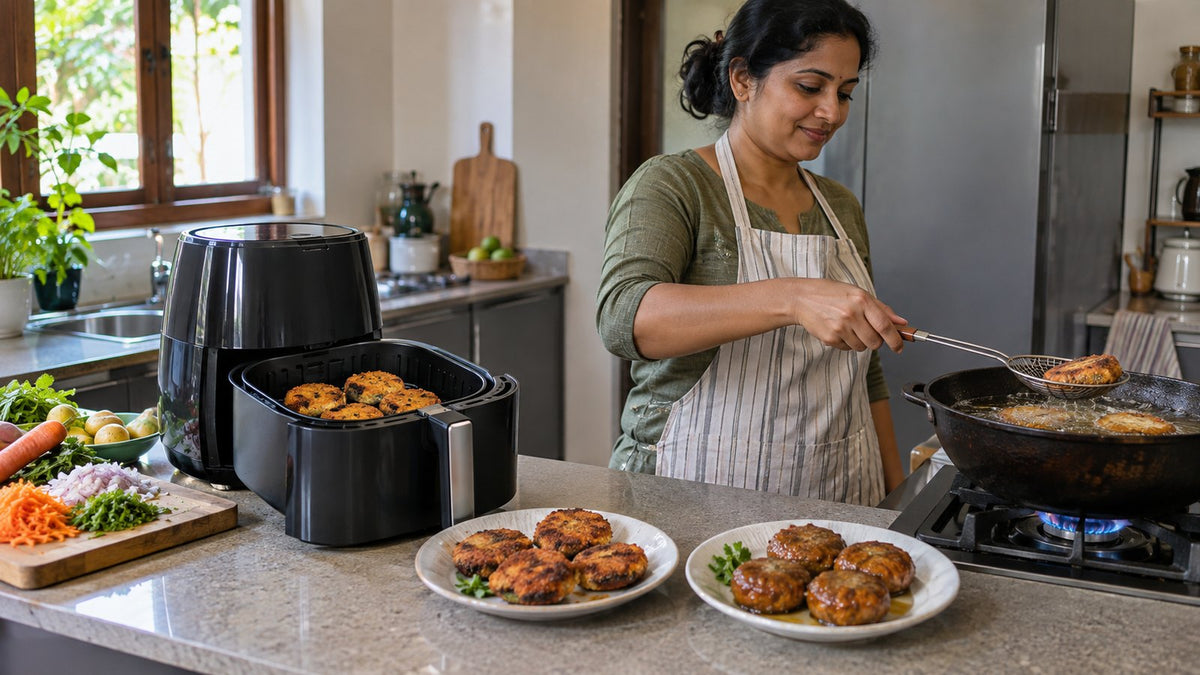
Cutlets, fish and chicken rolls, and devilled-style dishes with a light coating do genuinely well in an air fryer. You get a properly crisp exterior with a fraction of the oil, because these dishes are relatively small, coated pieces that benefit from hot air circulation. Roast chicken and chicken drumsticks also work well, often better than pan frying for even cooking. Reheating leftover rice-and-curry sides like fried fish or cutlets the next day is genuinely one of the best uses of an air fryer: crisper than a microwave, no added oil needed.
What doesn't air-fry well: the honest limitations
Wadai and other batter-based fritters that rely on being fully submerged in hot oil to set their shape and texture don't translate well to an air fryer. The batter doesn't hold together the same way without oil surrounding it, and the texture ends up dry rather than crisp-outside-soft-inside. Large batches for a family gathering or a full kadala vada fry-up are also impractical. An air fryer basket is a fraction of the volume of a kadai, so you're doing multiple rounds where deep frying handles it in one go. If you're frying for a crowd, a kadai still wins on speed and volume.
Worth knowing
The health angle, without overselling it
An air fryer genuinely uses significantly less oil per serving than deep frying, which matters if you're managing cholesterol or just trying to cut down oil intake generally. It's not a magic health fix. The food is still fried, just with far less oil absorbed, but for households cooking fried food several times a week, the reduction in oil intake over months adds up in a way that's worth taking seriously, without treating it as a cure-all.
So, is an air fryer worth it for a Sri Lankan household?
If you deep fry cutlets, rolls, or chicken pieces two or three times a week, an air fryer pays for itself in oil savings within about four to seven months and cuts the smoke and smell out of your kitchen. If your household mainly deep fries wadai and other batter fritters, or fries in large batches for gatherings, keep the kadai; an air fryer will sit half-used. Most Sri Lankan kitchens end up running both: kadai for batch frying and batter-based snacks, air fryer for everyday cutlets, rolls, and reheating.
The Greenlife Glass Air Fryer 4.5L's 4.5L capacity and 1200W element, backed by Green Life's 1-year warranty support, are sized for a family batch of cutlets or a small roast chicken in one round, which is the sweet spot for the dishes that genuinely benefit from switching over from deep frying.
Frequently Asked Questions
Is an air fryer actually cheaper than deep frying long-term?
Yes, for households that fry regularly. Oil costs roughly Rs 3,000 to 5,000/month for regular deep frying, versus roughly Rs 250 to 400/month in electricity for equivalent air frying. At Rs 18,999, the Greenlife 4.5L air fryer typically pays for itself in oil savings within about four to seven months of regular use.
Can I make wadai or vadai in an air fryer?
Not well. Batter-based fritters that rely on being submerged in oil to set their shape don't hold together properly in an air fryer and come out drier rather than crisp. For wadai, kadala vada, and similar dishes, a kadai with proper oil still gives the better result.
Do cutlets and fish rolls taste as good from an air fryer?
Very close, and for many people just as good. You get a genuinely crisp coating with a fraction of the oil. The main difference is a slightly less greasy mouthfeel, which most households consider a positive rather than a downside.
Is it worth having both a kadai and an air fryer?
For most active Sri Lankan kitchens, yes. The air fryer handles everyday cutlets, rolls, and reheating with far less oil and mess, while the kadai stays for batter-based fritters and large-batch frying for gatherings that an air fryer basket can't handle in one round.
How much oil does an air fryer actually save per use?
For coated items like cutlets or chicken pieces, an air fryer typically uses a light spray or brush of oil (a fraction of a tablespoon) compared to the cup or more of oil absorbed and discarded in a typical deep-frying session for the same quantity.
Need a hand choosing?
Not sure if air frying suits how your household actually cooks? WhatsApp us and we'll give you a straight answer, not a sales pitch: 0776882898.
Shop the Greenlife Glass Air Fryer 4.5LBrowse the Green Life CollectionWhatsApp 0776882898