

Hard Anodised vs Stainless Steel Pressure Cookers: Health, Durability and Price
Once you've decided a pressure cooker needs to handle more than daily dhal and rice, the next question is usually material, and specifically whether hard anodised or stainless steel is worth the premium over standard aluminium. Both get marketed as the "upgrade" option, but they're genuinely different materials solving different problems. Here's an honest breakdown, including where they sit against the GreenChef cookers we sell: aluminium Namo and Evok, and the stainless steel Classic.
Quick answer
- Hard anodised is treated aluminium: light, heats fast and evenly, needs gentle cleaning.
- Stainless steel is non-reactive by nature, with no surface to wear through; it depends on a good base for even heat.
- For daily dhal and rice, a standard aluminium cooker (GreenChef Namo 5L, Rs 7,099) does the job.
- Cook acidic gravies every day? The GreenChef Classic stainless steel cooker is Rs 5,999 to 9,799.
In this guide
What's Actually Different Between Hard Anodised and Stainless Steel?
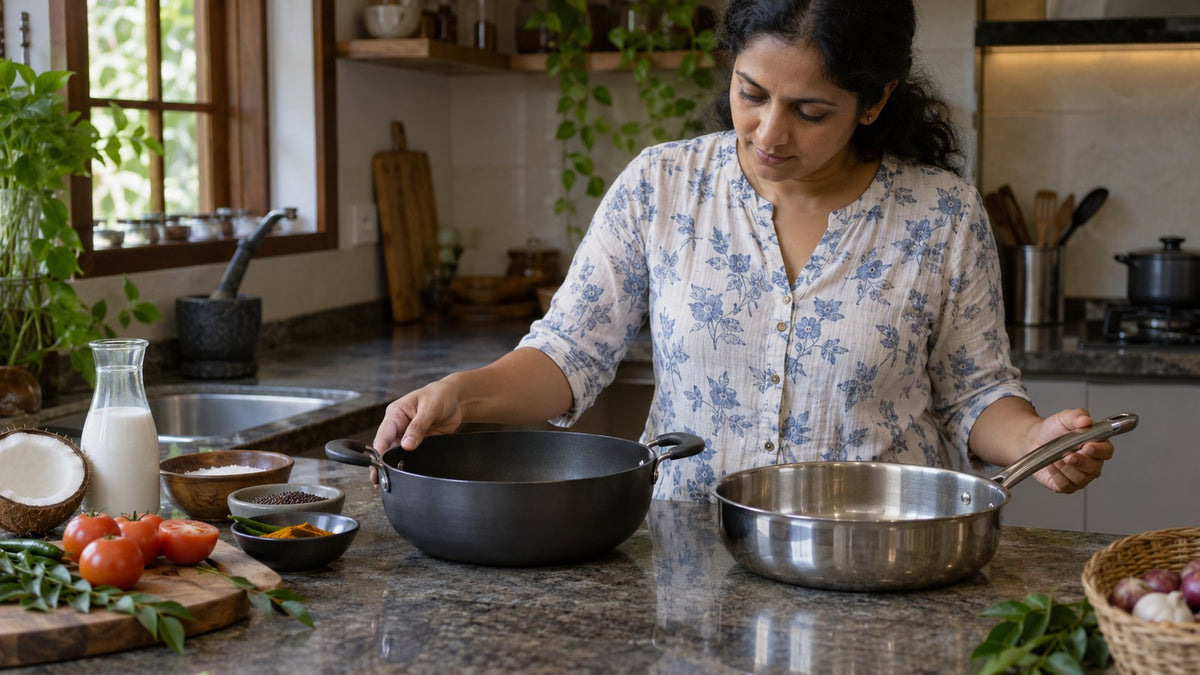
Hard anodised cookware starts as an aluminium base, electrochemically treated to thicken and harden the natural oxide layer on the surface, producing a dark grey, matte finish that's significantly harder than raw aluminium. The aluminium core underneath is what gives it fast, efficient heat conduction, the anodising only changes the surface, not the metal doing the actual heat transfer.
Stainless steel pressure cookers are usually a different construction entirely. Plain stainless steel on its own conducts heat poorly, so quality stainless cookers use a multi-ply or clad base, typically stainless steel bonded around a core disc of aluminium or copper, to spread heat evenly at the bottom. That clad construction is part of why good stainless steel pressure cookers cost more than a simple hard-anodised pot of the same size.
Heat Distribution: Which Heats More Evenly?
Hard anodised cookware, with aluminium as the base metal throughout, heats quickly and distributes heat evenly across the whole body, not just the base, which suits fast dhal and rice cooking well. Stainless steel depends entirely on the quality of its base construction: a well-made multi-ply stainless cooker with a thick aluminium or copper disc heats evenly too, but a cheaper stainless cooker with a thin base disc can develop hot spots that scorch food at the bottom before the rest of the pot catches up. This is the detail budget stainless steel listings rarely mention.
Health and Reactivity: Does It Matter for Sri Lankan Cooking?
This is where the two materials genuinely differ in how they achieve the same result. Hard anodised cookware is non-reactive with acidic ingredients, tomato-based curries, tamarind, vinegar-forward dishes like ambul thiyal, once its hardened oxide surface stays intact. That surface is the entire protection layer; avoid steel wool and harsh scouring, and it stays non-reactive for years. Stainless steel is non-reactive by nature of the metal itself, not a surface treatment, so there's no coating or oxide layer to wear through in the first place. In practical terms, stainless steel is the more foolproof of the two for households that cook acidic gravies very frequently and don't want to think about surface care at all, while hard anodised delivers the same non-reactive result as long as the surface is treated reasonably gently.
Durability and Price Comparison
| Feature | Hard Anodised | Stainless Steel (quality multi-ply) |
|---|---|---|
| Heat distribution | Fast and even, aluminium core throughout | Even only with a good aluminium/copper base disc; thin-base models can develop hot spots |
| Reactivity with acidic curries | Non-reactive while the hardened oxide surface stays intact | Naturally non-reactive, no surface layer to wear through |
| Scratch and wear resistance | High, but the oxide layer can eventually wear down with steel wool or metal utensils | Very high; solid metal doesn't wear through the way a surface treatment can |
| Weight | Lighter, aluminium-based | Noticeably heavier, especially clad multi-ply construction |
| Hard water spotting (interior) | Less visible on the darker matte finish | Can show white mineral spotting with hard water; wipes off with a vinegar rinse, cosmetic only |
Green Life stocks one of the two: the GreenChef Classic stainless steel pressure cooker in 2L, 3L and 5L (Rs 5,999 to 9,799), alongside the aluminium Namo and Evok range. We do not sell a hard anodised cooker. Whichever you buy, check local warranty and spare parts, gaskets and valves especially, which matter a great deal once a cooker is a few years old and the seal starts hissing.
Verdict by Use Case
For a typical household cooking dhal, rice, and the occasional meat curry a few times a week, a standard aluminium pressure cooker with a local warranty does the job well. The GreenChef Pressure Cooker Namo 5L covers that daily use case well, with a 1-year warranty and spare gaskets available in Sri Lanka.
If you cook acidic gravies almost daily, biryani masalas, tomato-heavy mutton curry, tamarind fish, and want the least maintenance-dependent option, stainless steel is the more foolproof choice since there's no surface layer to eventually wear through. If you want fast, even heating with a lighter pot to lift on and off the stove, and you're willing to avoid steel wool and metal utensils to protect the surface, hard anodised is the better fit. If stainless steel is what you want, the GreenChef Classic stainless steel pressure cooker works on gas and induction, with a 1-year warranty.
Frequently Asked Questions
Is hard anodised or stainless steel better for health?
Both are considered safe and non-reactive with food when properly made. Hard anodised achieves this through a hardened surface layer that needs reasonable care to stay intact; stainless steel is non-reactive by nature of the metal, with no surface layer to maintain, making it the more foolproof option for very frequent acidic cooking.
Which heats more evenly, hard anodised or stainless steel?
Hard anodised heats evenly by default, since it's aluminium throughout. Stainless steel only heats evenly if it has a quality aluminium or copper base disc; cheaper stainless cookers with a thin base can develop hot spots that scorch food.
Does Green Life sell hard anodised or stainless steel pressure cookers?
Stainless steel, yes: the GreenChef Classic in 2L, 3L and 5L. Hard anodised, no. Our other GreenChef cookers, Namo and Evok, are aluminium, from 3L to 12L.
Will hard water leave marks inside a stainless steel pressure cooker?
It can, usually as light white mineral spotting from Sri Lanka's harder water areas. It's cosmetic, not a safety issue, and wipes off with a vinegar rinse or a soft scrub with baking soda.
Is it worth paying extra for stainless steel over a standard aluminium pressure cooker?
For typical Sri Lankan cooking frequency, dhal, rice, and curry a few times a week, usually not. The extra cost pays off mainly for households cooking very acidic dishes daily at high volume, where stainless steel's zero-maintenance non-reactivity becomes genuinely useful rather than a marginal benefit.
Need a hand choosing?
Not sure whether aluminium or stainless steel suits you? WhatsApp us what you cook most on 0776882898 and we'll give you an honest answer.