


Spice Grinder vs Mortar and Pestle: Does the Miris Gala Still Win?
Ask any Sri Lankan grandmother whether an electric grinder can replace a miris gala and you'll get a firm answer, usually "no," often before you've finished asking. The flat granite grinding stone, worked with a smaller hand stone called a gala gethiya, has ground chilli, coconut, and spice pastes in Sri Lankan kitchens for generations, and it isn't sitting in a museum; it's still sitting in working kitchens from Galle to Jaffna. An electric spice grinder does a related but genuinely different job. Here's a fair comparison of what each one actually gives you.
Quick answer
- The miris gala still wins for wet pastes: coconut sambol, chilli and ginger-garlic.
- An electric spice grinder wins for dry jobs: roasted curry powder, pepper and coffee in under a minute.
- Most kitchens keep both and use each for its own half of the job.
- The Greenlife 300W coffee and spice grinder is Rs 2,099.
In this guide
- What Does a Miris Gala Actually Do That a Grinder Doesn't?
- What Does an Electric Spice Grinder Do Differently?
- What Do Traditionalists Say Gets Lost?
- Where Does an Electric Grinder Genuinely Fit?
- Miris Gala vs Electric Spice Grinder, Task by Task
- So Does the Miris Gala Still Win?
- Frequently Asked Questions
What Does a Miris Gala Actually Do That a Grinder Doesn't?
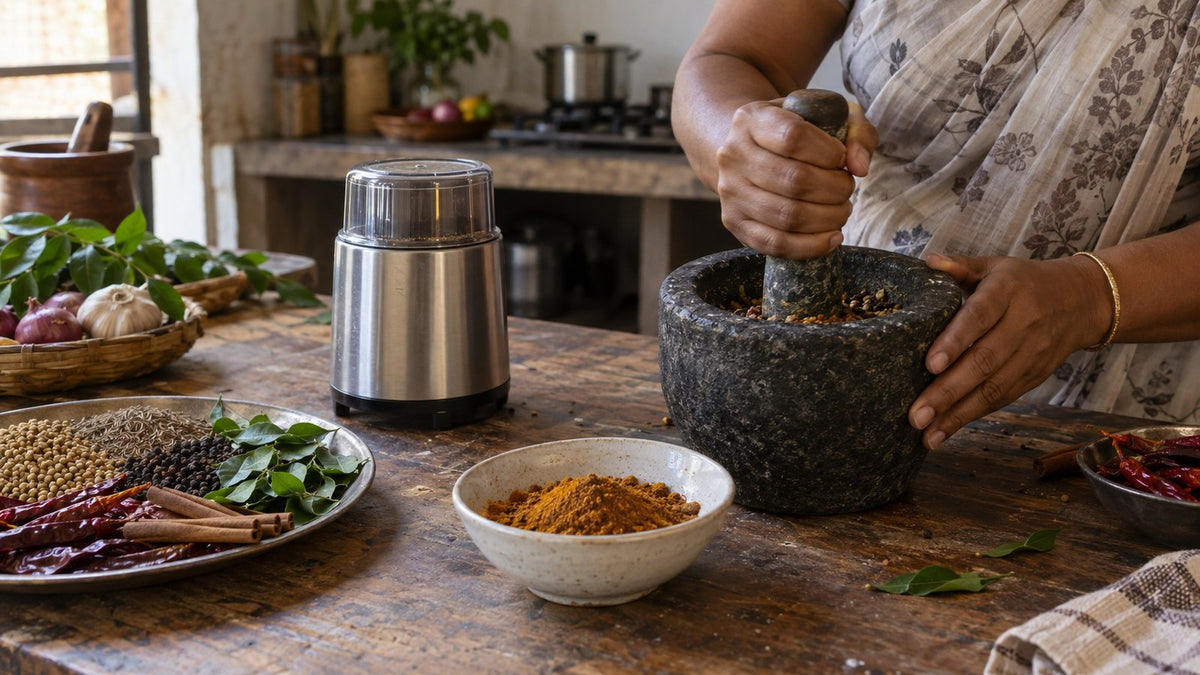
The miris gala grinds by crushing and shearing ingredients between two flat stone surfaces under manual pressure, which produces a wet, textured paste, not a dry powder, ideal for a coconut sambol, a chilli paste for a curry base, or ginger-garlic paste ground fresh right before it hits the pan. That crushing action releases oils from ingredients like chilli and coconut differently than a spinning blade does, and it's why many Sri Lankan cooks insist a sambol ground on stone genuinely tastes different from one made in a blender jar. There's a control element too: an experienced hand can feel exactly how coarse or fine a paste is getting in a way a machine's fixed pulse can't quite replicate, and grinding by hand at your own table, in your own rhythm, is part of the cooking ritual in many homes, not a chore to eliminate.
What Does an Electric Spice Grinder Do Differently?
An electric spice grinder like the Greenlife Electric Coffee & Spice Grinder (300W), covered in more detail in our coffee and spice grinder guide, is a blade-type pulse grinder built for dry ingredients: roasted coriander, cumin, fennel, dried chillies, and whole peppercorns turned into curry powder, not wet pastes. It does a genuinely different job well: speed, a batch of roasted curry powder ready in under a minute, consistency, every batch ground to the same texture without arm fatigue, and less physical effort, which matters on a weeknight after work in a way it doesn't on a Sunday spent cooking for the week ahead.
What Do Traditionalists Say Gets Lost?
The honest losses are real, not imagined. A dry blade grinder can't replicate the wet-paste texture a miris gala produces for coconut or chilli sambol; feeding wet or oily ingredients into a small dry jar gums up the blade and doesn't grind evenly. Texture control is coarser with a grinder's fixed pulse than with an experienced hand working stone. And there's the ritual and the technique passed down through a family that a motor simply doesn't carry. None of this makes the grinder a lesser tool; it makes it a different one, built for a different half of the spice-prep job.
Where Does an Electric Grinder Genuinely Fit?
The honest answer is alongside the miris gala, not instead of it. A grinder earns its counter space for the dry side of spice prep, roasted curry powder, ground pepper, and coffee, which is exactly what our coffee and spice grinder guide covers in detail, including batch sizes and how to clean between spices so flavours don't mix. The miris gala keeps its job for wet pastes, coconut sambol, and chilli paste. Most well-stocked Sri Lankan kitchens, honestly, still have both, used for different halves of the same meal.
Miris Gala vs Electric Spice Grinder, Task by Task
| Task | Miris Gala | Electric Spice Grinder (300W) |
|---|---|---|
| Wet coconut or chilli sambol paste | Genuinely better; texture and oil release | Not suited; gums up a dry blade jar |
| Roasted curry powder (dry spices) | Possible but slow and physically demanding | Fast, consistent, ready in under a minute |
| Ground pepper | Works well | Works well |
| Ginger-garlic paste | Traditional method, fresh texture | Not built for wet pastes |
| Coffee beans | Not applicable | Genuinely good; same jar doubles for coffee |
| Physical effort | High; requires kneeling or bending over the stone | Minimal; push a button |
| Batch size | Whatever the cook grinds by hand, no fixed limit | Small batches |
| Price in Sri Lanka | Often inherited; new stones vary widely | Rs 2,099 standalone, Rs 3,499 for the 2-in-1 with juice blender |
| Cleaning | Rinse and dry the stone; not a two-minute job | Wipe dry between spices, occasional rinse of the jar only |
So Does the Miris Gala Still Win?
For wet pastes, yes, honestly, nothing sold in an appliance shop replicates it properly. For dry spice grinding and coffee, the electric grinder wins on time and consistency without giving up flavour, since roasted, freshly ground curry powder from a 300W blade grinder still beats shop-bought pre-ground powder in every kitchen we've heard from. The realistic answer for most households isn't picking one over the other; it's using each for the job it does best.
Frequently Asked Questions
Can an electric spice grinder replace a miris gala completely?
Not for wet pastes like coconut or chilli sambol; a dry blade grinder can't replicate that texture and gums up if you try. For dry spice grinding, roasted curry powder, and pepper, it's a genuine, faster alternative.
Does grinding on a miris gala actually taste different?
Many Sri Lankan cooks say yes. The crushing and shearing action on stone releases oils from chilli and coconut differently than a spinning blade, giving sambols and pastes a texture a blade grinder doesn't produce.
What can the Greenlife Electric Coffee & Spice Grinder actually handle?
Dry ingredients only, roasted coriander, cumin, fennel, dried chillies for curry powder, whole peppercorns, and coffee beans, in small batches. It isn't built for wet pastes or bulk grinding.
Is it worth buying an electric grinder if I already have a miris gala at home?
Yes, for most households, since they cover different jobs. The miris gala stays essential for wet sambols and pastes; the electric grinder saves real time and effort on dry curry powder and coffee.
How much does a genuine electric spice grinder cost in Sri Lanka?
The standalone Greenlife Electric Coffee & Spice Grinder (300W) is Rs 2,099 at Green Life. The 2-in-1 version with a compact juice blender is Rs 3,499, for households that want both functions in one unit.
Need a hand choosing?
Not sure whether you need the standalone grinder or the 2-in-1 combo? WhatsApp us how you cook day to day and we'll help you decide honestly, miris gala included: 0776882898. Either option comes with a 1-year warranty.